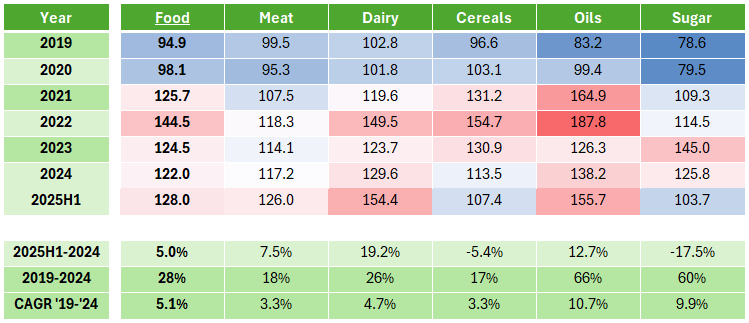
The FAO Food Price Index reached 128.0 points in the first half of 2025, marking a significant increase of +5% compared to 2024. However, this overall figure masks diverse realities across major food commodity categories. In this article, we provide a detailed analysis of recent developments and underlying trends in key global agricultural markets: cereals, sugar, vegetable oils, meat, and dairy products.
🌾 Cereals: Market Returning Towards Normality
Analysis of H1 2025
During the first six months of 2025, cereal prices declined by 5.4%, confirming a downward trend that began in previous years. This decrease is mainly due to a significant increase in global supply. Record maize harvests in Argentina and Brazil notably boosted global availability, alleviating previously observed inflationary pressures.
Additionally, exports from major producing countries have improved, contributing to easing international market tensions. Nonetheless, this improvement does not signify a complete return to normalcy: prices remain elevated at 107.4 points, still 11% above the pre-pandemic level of 2019.
Trends since 2019
Since 2019, the cereal market has experienced substantial volatility. The historical peak recorded in March 2022, at 154.7 points, was directly linked to the war in Ukraine, significantly disrupting wheat and maize exports from the Black Sea region. This geopolitical crisis compelled many countries to diversify their supply sources, sustaining elevated prices until recently.
The gradual decline since this peak reflects a relative normalization of trade flows and increased supply-chain resilience. However, long-term impacts remain evident in current price levels, which continue to exceed pre-crisis benchmarks.
🍬 Sugar: Major Correction Following a Speculative Surge
Analysis of H1 2025
The global sugar market experienced a significant drop of 17.5% in the first half of 2025. This reduction was primarily driven by considerably improved harvests in key producing countries such as Brazil, India, and Thailand, benefiting from particularly favorable weather conditions.
This increased supply coincided with relatively moderate global demand, influenced by worldwide economic uncertainties that dampened industrial sugar consumption across many key markets.
Trends since 2019
Between 2019 and 2023, the sugar market endured considerable volatility, highlighted by an intense speculative surge in 2023, driving the index to an historic high of 145.0 points. This spike resulted from consecutive poor harvests, pandemic-related logistical disruptions, and significant speculation in futures markets.
Since this peak, steady improvements in harvest conditions and gradual demand slowdown have allowed prices to return to more stable levels, comparable to pre-surge values.
🌿 Vegetable Oils: Between Volatility and Cyclical Rebounds
Analysis of H1 2025
Vegetable oils recorded a marked increase of 12.7% in the first half of 2025. This rise was primarily driven by strong international demand fueled by increased biodiesel sector needs and significant seasonal fluctuations in major producing countries, particularly palm oil production in Southeast Asia.
Trends since 2019
The vegetable oil market has historically been among the most volatile agricultural sectors. The Russo-Ukrainian conflict in 2022 caused a major crisis in global markets due to Ukraine’s pivotal role as a major sunflower oil exporter, driving prices to a historic peak of 187.8 points.
Following this major disruption, prices have undergone successive corrections due to gradual adjustments in trade flows and partial substitutions between different vegetable oil categories. Nevertheless, fundamental market conditions remain sensitive to climatic variations and rapid industrial demand changes, explaining frequent price rebounds.
🥩 Meat: Persistent Structural Inflation
Analysis of H1 2025
The meat sector continued its inflationary trajectory with a notable increase of 7.5% in the first half of 2025, reaching a new historic record. This increase is primarily due to robust global demand, particularly from the United States and Asia, against a backdrop of constrained global meat supply resulting from persistent health issues (animal epidemics) and structurally reduced export capacities in certain key producing countries.
Trends since 2019
Since 2019, the global meat market has faced significant structural challenges, primarily due to major health crises such as African Swine Fever and successive avian flu outbreaks. These crises have durably affected global supply, driving sustained price inflation worldwide.
Meat sector inflation thus appears structural and enduring, with limited prospects for a swift return to more moderate price levels.
🧈 Dairy Products: Persistently High Market Tension
Analysis of H1 2025
Dairy products experienced the most significant price increase across all categories, rising 19.2% over the first half of the year. This dramatic surge is driven by persistently strong Asian demand, particularly for powdered milk and butter, while production in Europe and Oceania remains constrained by challenging climatic conditions and increased regulatory pressures.
Trends since 2019
Since 2019, the dairy sector has consistently experienced tensions driven by limited supply and rising Asian demand, particularly from China. Prices peaked historically in 2022, followed by a brief easing, and subsequently a renewed surge in 2025.
This ongoing structural trend towards continued inflation clearly indicates a persistently unbalanced dairy market skewed toward demand.
📌 Conclusion: A Complex and Multidimensional Market
These detailed analyses clearly demonstrate that global food markets cannot be simplified into a single overarching trend. Each commodity category presents unique dynamics influenced by factors such as geopolitics, climatic conditions, health issues, and industrial demand. Understanding these factors is crucial for anticipating future developments and effectively adapting pricing, financial, and risk management strategies.